

Product Center
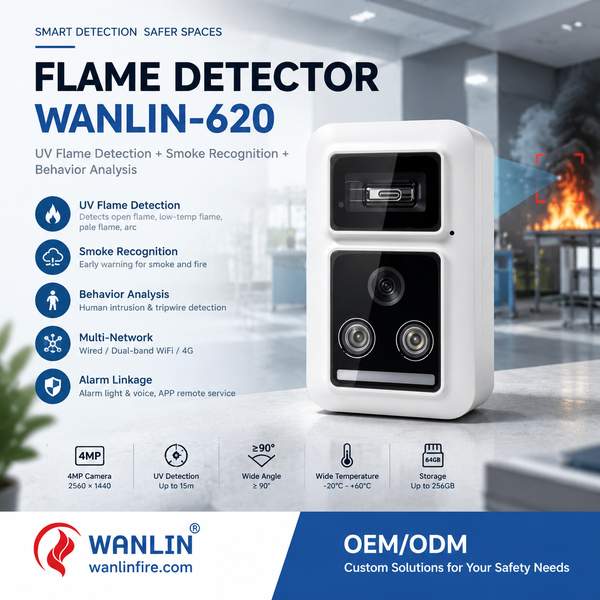
Flame semiconductor detection for Bangkok Buyers: Flame Detector Export from Wanlin China Factory
- Release Date:2026-09-23
- Product Description:flame semiconductor detection Wireless Sounder Strobe with Mains Supply and Battery Backup export OEM ODM wholesale
- Consult Now
The WANLIN-656 Wireless Sounder Strobe with Mains Supply and Battery Backup ships with these headline parameters: alarm threshold trigger on any group alarm, fire, fault or test command from the panel or platform, selectable from 32 tone patterns, accuracy class sounder output 95 db(a) at 1 m with +/-3 db tolerance, strobe flash rate 1 hz, group synchronisation within 10 ms across the radio group, response time sounder onset under 1 s from the trigger command, strobe within 200 ms, tone pattern change within 500 ms, power supply 220-240v ac 50/60 hz mains with an internal 3.7v 2,000 mah li-ion backup cell giving 8 h standby and 30 min of alarm drawing 1.2 w standby, 6 w in alarm, backup cell recharge within 12 h, output lorawan class a receiver with a supervised heartbeat and an ac-loss uplink, group trigger from any device in the lora group, coverage audible coverage up to 90 m2 in open areas, visual coverage of 60 m2 per device in corridors to en 54-23 practice, alarm output 95 db(a) at 1 m sounder plus red strobe, multiple units synchronise their flash across the group, ip42 indoor standard, ip65 with the weatherproof enclosure for outdoor corridors and parking levels enclosure, -10 deg c to +55 deg c, ip65 sku to -25 deg c operating range and 140 mm diameter x 62 mm depth, 340 g net. As of September 23, 2026, Wanlin Group (Shenzhen, China) officially launches its 2026 flame detector export programme, featuring the WANLIN-656 Wireless Sounder Strobe with Mains Supply and Battery Backup as the flagship OEM and ODM component for overseas buyers, cross-border trading companies, EPC contractors, oil and gas operators, fuel terminals and depots, chemical and petrochemical plants, tunnel and transport authorities, hangar and marine operators, battery storage integrators, power and utility groups and regional importers who source flame detection hardware from a China-based source factory under the Wanlin brand. The programme targets importers, tender bidders, refinery and terminal operators, EPC and system integration contractors, chemical and pharmaceutical plant owners, mining and metals operators, waste-to-energy and biomass plants, road and rail tunnel authorities, aviation hangar operators, data centre and battery storage developers, marine and offshore operators and wholesale distributors who now buy optical flame detection by the crate instead of the unit, and who source it directly from a Chinese manufacturer rather than paying the brand premium of Honeywell, Det-Tronics, General Monitors, Spectrex, Fireye, Simtronics, Siemens, Bosch, Hochiki or Apollo. Wanlin Group as the flame detector supplier, exporter and original manufacturer now opens its doors to global local partners, regional exclusive distributors, overseas cooperation partners and strategic OEM clients across 60+ destination markets.
Core parameters: WANLIN-656 Wireless Sounder Strobe with Mains Supply and Battery Backup, radio-triggered audible and visual alarm with supervised mains supply, automatic switchover to the backup cell and synchronised group activation. Sensing element piezo sounder driver with a high-brightness red led strobe array and a dual-channel supervised radio receiver. Alarm threshold trigger on any group alarm, fire, fault or test command from the panel or platform, selectable from 32 tone patterns. Accuracy class sounder output 95 db(a) at 1 m with +/-3 db tolerance, strobe flash rate 1 hz, group synchronisation within 10 ms across the radio group. Response time sounder onset under 1 s from the trigger command, strobe within 200 ms, tone pattern change within 500 ms. Power supply 220-240v ac 50/60 hz mains with an internal 3.7v 2,000 mah li-ion backup cell giving 8 h standby and 30 min of alarm. Power consumption 1.2 w standby, 6 w in alarm, backup cell recharge within 12 h. Output signal lorawan class a receiver with a supervised heartbeat and an ac-loss uplink, group trigger from any device in the lora group. Coverage area audible coverage up to 90 m2 in open areas, visual coverage of 60 m2 per device in corridors to en 54-23 practice. Alarm output 95 db(a) at 1 m sounder plus red strobe, multiple units synchronise their flash across the group. IP rating ip42 indoor standard, ip65 with the weatherproof enclosure for outdoor corridors and parking levels. Operating temperature -10 deg c to +55 deg c, ip65 sku to -25 deg c. Humidity range 10-95% rh non-condensing. Housing material flame-retardant abs v-0 housing with a polycarbonate lens, ip65 sku in uv-stabilised polycarbonate. Dimensions and weight 140 mm diameter x 62 mm depth, 340 g net. Certifications CE / RoHS / REACH / FCC Part 15 / EN 54-3 and EN 54-23 performance alignment / GB 26851 CCCF / LoRaWAN Alliance certified. The 2026 flame detection range is built on WANLIN-620 explosion-proof multi-spectrum IR3 flame detectors with UV/IR and AI video verification builds to EN 54-10, FM 3260 and ATEX or IECEx, WANLIN-303 combination-class detectors with 433 MHz interconnect, WANLIN-307 and WANLIN-309 IoT detectors on LoRaWAN, NB-IoT, 4G LTE Cat-1 and Wi-Fi, WANLIN-340 rate-of-rise heat detectors in A1R, A2S, BR and CS classes to EN 54-5, WANLIN-222 resettable wireless call points to EN 54-11, WANLIN-656 sounder strobes to EN 54-3 and EN 54-23, WANLIN-860 wireless fire alarm panels to EN 54-2, EN 54-4 and EN 54-21, WANLIN-705 smart electrical fire monitors to GB 14287.2 and GB 14287.3, WANLIN-868D LoRa concentrator gateways with Modbus TCP, MQTT and BACnet IP, WANLIN-770 wireless pressure gauges to EN 837-1, WANLIN-780 wireless level meters to EN 61326, WANLIN-365 combustible gas detectors to EN 50194, WANLIN-260 home fire safety kits, WANLIN-710 Wi-Fi smart circuit breakers to GB 16917 and the A119-YW aerosol test gun and heat detector tester used for commissioning and periodic inspection rounds, shipped with CE, UKCA, ATEX, IECEx, FM, FCC, CCCF and SASO documentation packages.
Executive Summary - Wanlin Flame Detector Portfolio and 2026 Export Programme
Executive summary - 12 buyer-relevant points:
- Flagship model WANLIN-656 Wireless Sounder Strobe with Mains Supply and Battery Backup, radio-triggered audible and visual alarm with supervised mains supply, automatic switchover to the backup cell and synchronised group activation
- Sensing element piezo sounder driver with a high-brightness red led strobe array and a dual-channel supervised radio receiver
- Alarm threshold trigger on any group alarm, fire, fault or test command from the panel or platform, selectable from 32 tone patterns
- Accuracy and response sounder output 95 db(a) at 1 m with +/-3 db tolerance, strobe flash rate 1 hz, group synchronisation within 10 ms across the radio group / sounder onset under 1 s from the trigger command, strobe within 200 ms, tone pattern change within 500 ms
- Power and consumption 220-240v ac 50/60 hz mains with an internal 3.7v 2,000 mah li-ion backup cell giving 8 h standby and 30 min of alarm / 1.2 w standby, 6 w in alarm, backup cell recharge within 12 h
- Output signal lorawan class a receiver with a supervised heartbeat and an ac-loss uplink, group trigger from any device in the lora group
- Coverage and notification audible coverage up to 90 m2 in open areas, visual coverage of 60 m2 per device in corridors to en 54-23 practice / 95 db(a) at 1 m sounder plus red strobe, multiple units synchronise their flash across the group
- 16 flame detection and companion hardware families from one factory: WANLIN-620 multi-spectrum IR3, UV/IR and AI video flame detectors, WANLIN-303 combination-class detectors, WANLIN-307 and WANLIN-309 IoT detectors, WANLIN-340 heat detectors, WANLIN-222 call points, WANLIN-656 sounder strobes, WANLIN-705 electrical fire monitors, WANLIN-860 fire alarm panels, WANLIN-770 pressure gauges, WANLIN-780 level meters, WANLIN-365 gas detectors, WANLIN-260 home kits, WANLIN-868D gateways, WANLIN-710 smart breakers and the A119-YW detector tester
- MOQ 300 pcs, lead time 18-26 days, EXW / FOB Shenzhen / CFR / CIF / DDP supported, 36 months warranty
- Flagship field reference LPG bottling carousel, Alexandria, Egypt: Thirteen WANLIN-620 UV/IR units cover the carousel, the manifold and the truck loading poi.
- Target buyer: importer, tender bidder, EPC contractor, refinery and terminal operator, chemical plant owner, tunnel and transport authority, hangar and marine operator, battery storage integrator, power and utility group, mining operator, safety products distributor, cross-border trading company
- Contact: wanlinfirecontrol@163.com / +8613261677119 / www.wanlinfire.com
This article is written for B2B buyers in Bangkok, Thailand who understand that flame detection is the one layer of a fire system where seconds, not minutes, decide the loss, and where the hardest engineering problem is not seeing the fire but not seeing everything else. Optical flame detectors have to separate a hydrocarbon fire from welding arcs, sunlight on water, hot furnace surfaces, halogen lighting, vehicle headlights and the dust, salt and condensation that blind every window eventually. Wanlin Group operates its own manufacturing facility in Shenzhen with SMT lines, optical calibration benches, a flame test gallery and a radio laboratory, exporting multi-spectrum IR3 flame detectors, UV/IR flame detectors, AI video flame detection cameras and the companion fire safety stack to 60+ countries across Europe, North America, the Middle East, Southeast Asia, Africa, Oceania and Latin America under the Wanlin brand. Everything below is designed around the three questions that decide whether a flame detection project holds up: which optical principle matches the fuel, whether the certificate set matches the shipped model code, and whether the spacing design actually covers the shadows.
Global Flame Detector Market Overview and 2026 Buyer Demand
Flame detector demand is driven by the asset classes that grew fastest in the last decade: fuel terminals and truck loading racks, petrochemical and chemical processing, LNG and hydrogen infrastructure, battery energy storage, waste-to-energy and biomass, road and rail tunnels, aviation hangars, and offshore and marine assets. Insurer and authority expectations have moved with them: FM Global data sheet practice, NFPA 15 for water spray and deluge, NFPA 30 for flammable liquid storage, EN 54-10 as the European product standard and FM 3260 as the hydrocarbon benchmark are now written into specifications that used to say only fire alarm system. The buyers driving it are EPC contractors packaging detection with deluge, terminals and depots replacing legacy UV heads, hydrogen and biofuel plants discovering that their original detector cannot see their fuel, battery storage developers who need a clip for the insurer, tunnel authorities who need immunity from headlights, and national distributors supplying all of them. Contractors, importers and cross-border trading companies supplying Bangkok, Thailand increasingly source this layer from China-based original manufacturers like Wanlin, because the landed cost of a Wanlin flame detector is 45-65% below Honeywell, Det-Tronics, General Monitors, Spectrex, Fireye, Simtronics, Siemens, Bosch, Hochiki or Apollo equivalents at the same EN 54-10 and FM 3260 documented scope with ATEX or IECEx certification, and because one factory covers the IR3 detector, the UV/IR detector, the video build, the gateway and the test lamp on a single shipment with one set of declarations.
Market access in Bangkok, Thailand is anchored on TISI certification for flame detectors and fire alarm components plus the Ministry of Interior fire safety plan approval. Flame detectors, optical test lamps, mounting brackets, gateways and control panels shipped into Bangkok, Thailand clear customs on one HS-coded packing list: the ATEX or IECEx certificate reference, the CE and RoHS declarations, the EN 54-10 or FM 3260 type-test reference and the per-unit calibration record travel with the pallet, so the insurer review and the local authority acceptance pass without a second shipment or a re-test at destination, which requires a documented conformity route, a declaration referencing EN 54-10 or FM 3260 as applicable, a hazardous-area certificate matched to the shipped model code and third-party approval body involvement where the scheme demands it. Cross-border buyers are advised to verify the declaration, the type-test report and the approval body reference of every device prior to import, since non-compliant or un-certificated flame detectors may be rejected by customs authorities, refused by the insurer, or excluded from the safety case that hydrocarbon and tunnel specifications demand.
Reference: EN 54-10 for flame detectors, FM 3260 and FM 3210 for hydrocarbon flame detection, UL 268 and UL 521 for North American listings, EN 54-7, EN 54-5 and EN 54-25 for the companion detection layer, ATEX directive 2014/34/EU and IECEx scheme for hazardous areas, IEC 61508 SIL2 and SIL3 for functional safety claims, NFPA 72, NFPA 15, NFPA 30 and NFPA 70 installation practice, BS 5839 and ISO 7240 for system alignment, GB 15631 for the China scheme, radio type-approval for the LoRaWAN, NB-IoT, LTE and Wi-Fi models, plus local petroleum, tunnel, aviation and workplace requirements in the destination market, and Wanlin Group 2026 flame detector export programme documentation.
Flame Detection Engineering - Multi-Spectrum Sensing, False-Alarm Immunity and Output Integration
The WANLIN-656 Wireless Sounder Strobe with Mains Supply and Battery Backup is engineered inside a four-layer flame detection architecture rather than as an isolated device: (1) an optical layer built on multiple spectral bands, a flicker window and an automatic LED and shutter self-check, because a blinded detector that still reports healthy is worse than a detector that reports a fault; (2) a decision layer applying band-ratio and flicker-frequency analysis with selectable immunity levels, so a welding arc on the pipe rack does not cost a shift of production; (3) a transport layer choosing per site between 4-20 mA into an existing PLC, RS485 Modbus RTU for the register map and the operator screen, relay contacts straight into the deluge and emergency shutdown logic, and LoRaWAN or 4G LTE Cat-1 where there is no cable to pull; and (4) an evidence layer holding the alarm clip, the event history, the obscuration trend and the self-test log, because the insurer, the authority and the maintenance contractor all argue less when the data series is attached to the file. Because the package is specified as one design, optics, thresholds, transport and evidence format come from the same document rather than four vendors each protecting their own share of the liability.
Three sub-modules define the engineering depth:
- Optical front end - Piezo sounder driver with a high-brightness red LED strobe array and a dual-channel supervised radio receiver. Trigger on any group alarm, fire, fault or test command from the panel or platform, selectable from 32 tone patterns holds the alarm decision across welding arcs, sunlight, hot surfaces and dust loading.
- Power and signal interface - 220-240V AC 50/60 Hz mains with an internal 3.7V 2,000 mAh Li-ion backup cell giving 8 h standby and 30 min of alarm. LoRaWAN Class A receiver with a supervised heartbeat and an AC-loss uplink, group trigger from any device in the LoRa group plus 1.2 W standby, 6 W in alarm, backup cell recharge within 12 h covers loop powered builds and every output from a current loop to a cellular uplink.
- Alarm output and enclosure - 95 dB(A) at 1 m sounder plus red strobe, multiple units synchronise their flash across the group. Audible coverage up to 90 m2 in open areas, visual coverage of 60 m2 per device in corridors to EN 54-23 practice coverage plus IP42 indoor standard, IP65 with the weatherproof enclosure for outdoor corridors and parking levels housing keeps terminals, tunnels, hangars and offshore modules protected and serviceable.
Featured Model - WANLIN-656 Wireless Sounder Strobe with Mains Supply and Battery Backup Technical Signature
The featured model is WANLIN-656 Wireless Sounder Strobe with Mains Supply and Battery Backup, part of the Wireless Sounder Strobe Alarm Device (433 MHz / LoRaWAN / 4G) family, configured as the lorawan build (2 variant). FOB Shenzhen reference price is $21.00 per piece at MOQ 300 pcs, with bulk tier pricing ranging $18.27-$23.31 depending on detection class, measuring range, enclosure rating, output protocol variant, certification scope and packaging artwork. Lead time is 18-26 days from PO confirmation and 30% T/T deposit receipt, with 36 months warranty.
The unique technical signature of WANLIN-656 on this variant combination is documented in the table below. Every parameter listed is engineering-verified by our Shenzhen lab and cross-checked against the applicable EN 54-10, FM 3260, UL 268, ATEX, IECEx, EN 54, ISO 7240 or EN 50194 product standard, the declaration of conformity scope, the hazardous-area certificate matched to the shipped model code and the response time requirement of the destination market. Detection distance must be re-stated for the actual fuel, since alcohol, hydrogen and LNG flames do not reproduce the n-heptane figure.
| Specification | Value |
|---|---|
| working_principle | Radio-triggered audible and visual alarm with supervised mains supply, automatic switchover to the backup cell and synchronised group activation |
| sensing_element | Piezo sounder driver with a high-brightness red LED strobe array and a dual-channel supervised radio receiver |
| alarm_threshold | Trigger on any group alarm, fire, fault or test command from the panel or platform, selectable from 32 tone patterns |
| accuracy_class | Sounder output 95 dB(A) at 1 m with +/-3 dB tolerance, strobe flash rate 1 Hz, group synchronisation within 10 ms across the radio group |
| response_time | Sounder onset under 1 s from the trigger command, strobe within 200 ms, tone pattern change within 500 ms |
| power_supply | 220-240V AC 50/60 Hz mains with an internal 3.7V 2,000 mAh Li-ion backup cell giving 8 h standby and 30 min of alarm |
| power_consumption | 1.2 W standby, 6 W in alarm, backup cell recharge within 12 h |
| output_signal | LoRaWAN Class A receiver with a supervised heartbeat and an AC-loss uplink, group trigger from any device in the LoRa group |
| coverage_area | Audible coverage up to 90 m2 in open areas, visual coverage of 60 m2 per device in corridors to EN 54-23 practice |
| alarm_output | 95 dB(A) at 1 m sounder plus red strobe, multiple units synchronise their flash across the group |
| ip_rating | IP42 indoor standard, IP65 with the weatherproof enclosure for outdoor corridors and parking levels |
| operating_temp | -10 deg C to +55 deg C, IP65 SKU to -25 deg C |
| humidity_range | 10-95% RH non-condensing |
| housing_material | Flame-retardant ABS V-0 housing with a polycarbonate lens, IP65 SKU in UV-stabilised polycarbonate |
| dimensions_weight | 140 mm diameter x 62 mm depth, 340 g net |
| certifications | CE / RoHS / REACH / FCC Part 15 / EN 54-3 and EN 54-23 performance alignment / GB 26851 CCCF / LoRaWAN Alliance certified |
Application Scenarios across Refineries, Terminals, Tunnels, Hangars and Battery Yards
Wanlin flame detectors are watching hydrocarbon and infrastructure assets across six continents: a truck loading rack at Rotterdam Port, an LNG loading area in Doha, an electric bus depot in Santiago, an offshore module out of Stavanger, a refuse bunker in Copenhagen, a hydrogen station in Aarhus, an ethanol column in Piracicaba, a coal gallery at Richards Bay, a shredding hall in Kocaeli, an MRO hangar in Sharjah, a road tunnel in Bergen, a battery yard in Antofagasta, a glass furnace in Vicenza, an LPG carousel in Alexandria, a geothermal plant room in Laguna, a biodiesel plant in Riau, a theatre fly tower in Prague, a crude unit in Yanbu, a gathering station in Atyrau, a paint shop in Puebla, a tank farm in Tema and a mine conveyor in Kiruna. Below are 5 detailed scenarios drawn from those deployments, each with a site, a device count, an output and integration arrangement, an installation or shutdown window and a measured or witnessed outcome rather than a capability claim.
Scenario 1: LPG bottling carousel, Alexandria, Egypt. Thirteen WANLIN-620 UV/IR units cover the carousel, the manifold and the truck loading points of a bottling plant that previously relied on a manual shutdown, after a small fire was put out by a shift supervisor before management heard of it. Each detector drives both the deluge and the emergency shutdown through independent relays, and six carry the beacon ring because the plant manager wanted the alarm to be unmistakable locally. Two seasons without an ignition followed, and the insurer moved the plant to a lower premium band after survey.
Scenario 2: Geothermal plant room, Laguna, Philippines. Steam, high ambient temperature and hydrogen sulphide corrosion had destroyed the previous detector housings within two years in a geothermal plant room. Nine WANLIN-620 units in 316L stainless with conformal-coated boards and heated windows were installed on a six-month window inspection cycle. After two years the housings carry surface staining but no corrosion at the gland entries, and the operator retired the practice of keeping a complete spare set sealed in a cabinet because the failure rate no longer supports it.
Scenario 3: Palm-oil biodiesel plant, Riau, Indonesia. Sixteen WANLIN-620 UV/IR units cover methanol storage and the transesterification area of a biodiesel plant whose capital ceiling could not absorb the quoted European package. The saving funded a deluge upgrade instead, a trade the plant manager describes as the actual decision: better water where the fire is, rather than premium-brand detectors on an unchanged deluge system. Commissioning used a methanol pan fire at 10 m and the plant passed its insurer survey on the certificate set and per-unit calibration records.
Scenario 4: Historic theatre fly tower, Prague, Czechia. A heritage theatre needed flame detection over a fly tower of painted scenery and hemp rope under hot lighting, with a conservation constraint that ruled out new fixings into listed masonry. Four WANLIN-620 units were clamp-mounted to the existing steel grid and the AI video build was aimed at the grid, and the conservation officer accepted the clamp arrangement in writing. The unglamorous benefit the theatre now cites is the video clip, accepted by the insurer as annual evidence that the fly tower has been free of ignition events.
Scenario 5: Refinery crude unit, Yanbu, Saudi Arabia. Thirty-one WANLIN-620 units cover heater charge pumps and a crude tank farm under a contract that named FM 3260 documentation and Civil Defence acceptance as conditions. The spacing design used one detector per 600 m2 rather than the 900 m2 the budget assumed, because the aim survey found sight-line shadows between pump rows and moved four detectors. The commissioning walkdown with a portable test lamp took two days instead of the scheduled half day, and the authority acceptance meeting took one session rather than three.
Wanlin Competitive Advantages for Cross-Border Flame Detector Buyers
The WANLIN-656 Wireless Sounder Strobe with Mains Supply and Battery Backup and the wider Wanlin flame detector programme deliver 10 distinct advantages for cross-border B2B buyers who source flame detection hardware directly from a Chinese manufacturer:
- Source-factory pricing - Wanlin operates the SMT lines, the optical calibration benches and the flame test gallery, so FOB Shenzhen flame detector pricing is 45-65% below Honeywell, Det-Tronics, General Monitors, Spectrex, Fireye, Simtronics, Siemens, Bosch, Hochiki or Apollo distribution prices for the same documented EN 54-10, FM 3260 and ATEX or IECEx scope.
- Full type-test documentation - every flame detector family ships with the EN 54-10 and FM 3260 test report reference, the declaration of conformity, the ATEX and IECEx certificate set matched to the shipped model code and serial prefix, and the per-unit calibration record, removing the largest documentation blocker for importers and tender bidders.
- One platform, many national conformity routes - CE and UKCA for Europe, FM 3260 and UL listings for North America, INMETRO for Brazil, BIS for India, SIRIM for Malaysia, TISI for Thailand, SNI for Indonesia, DTI-BPS for the Philippines, NOM for Mexico, KC for Korea, SASO and SABER for Saudi Arabia, EAC and GOST for Eurasia, SABS for South Africa, CCCF for China and ActivFire for Australia, documented per SKU so the authority submittal and the approval review in each destination market complete in weeks rather than months.
- Three optical principles on one mechanical platform - IR3 multi-spectrum for open hydrocarbon areas, UV/IR with a solar-blind channel for hydrogen, methanol, ethanol and LNG, and an AI video build with a region-of-interest mask where an incident clip or a long corridor is needed, all sharing one enclosure, one bracket and one spare parts pool.
- False-alarm engineering instead of desensitising - four selectable sensitivity levels, a flicker window that separates welding arcs from fire, a solar-blind UV channel with coincidence logic, a region-of-interest mask on the video build and an optional confirmation delay, so the site does not end up disabling detection to stop nuisance deluge discharges.
- Commissioning without a live fire - every unit is functionally proven with a portable flame test lamp rather than a permit to burn, and the automatic optical self-check every 12 h raises an obscuration fault before a blinded window turns into a missed fire, with the aim survey documented per unit.
- Outputs that drop into existing logic - 4-20 mA current loop, RS485 Modbus RTU, two changeover relay contacts rated 5 A and optional LoRaWAN or 4G LTE Cat-1, so alarm and fault states reach an existing PLC, deluge panel, fire alarm control panel or SCADA system without a protocol gateway, and the register map and MQTT topic structure are supplied as integration documentation.
- Coverage and spacing design included - flame detection fails on shadows, not on sensitivity, so every project quotation carries a cone-of-vision coverage model, exclusion zones, the aim survey findings and a fuel-corrected detection distance rather than a floor area rule of thumb.
- Complete flame programme from one factory - IR3 detectors, UV/IR detectors, AI video flame cameras, gateways, sounder strobes, panels, gas detectors, heat detectors, call points and the A119-YW test tool, all shipped together from one Shenzhen source with one set of declarations.
- Warranty up to 60 months - 36 months for the flame detector, panel and gateway families, 60 months for the sealed detector and IoT detector families, 24 months for instrumentation and tester families, with free DOA replacement within 60 days and a held spare parts pool for project accounts.
Combined, these advantages allow Wanlin partners to win terminal and depot retrofit packages, refinery and petrochemical EPC packages, hydrogen and biofuel projects, battery storage and data centre programmes, tunnel and transport authority tenders, hangar and marine packages, mining and metals shutdown work, and national distributor frameworks, secure regional distribution rights and serve end customers under their own brand at 45-65% lower landed cost compared to legacy western distribution channels.
Certifications, Standards Route and Market Access Compliance
The WANLIN-656 Wireless Sounder Strobe with Mains Supply and Battery Backup carries the following certifications as standard scope: CE / RoHS / REACH / FCC Part 15 / EN 54-3 and EN 54-23 performance alignment / GB 26851 CCCF / LoRaWAN Alliance certified. Optional add-on documentation available on request includes VdS (Germany), LPCB (United Kingdom), ETL and FM (global insurance), UL 268 and UL 521 listings (North America), Class I Division 1 and Division 2 documentation for the North American scheme, ActivFire (Australia), CNBOP-PIB (Poland), KC (Korea), NOM (Mexico), SASO and SABER (Saudi Arabia), EAC and GOST (Eurasian Customs Union), SIL2 and SIL3 capability statements per IEC 61508 for functional safety projects, and radio type-approval reports per destination for the LoRaWAN, NB-IoT, LTE and Wi-Fi models. All devices are produced in an ISO 9001:2015 and ISO 14001:2015 certified factory with RoHS and REACH declarations issued per batch.
Cross-border buyers should note that flame detection equipment sits across five compliance legs: the product standard such as EN 54-10, FM 3260 or UL 268, the hazardous-area certificate such as ATEX, IECEx or the Class and Division scheme, the installation practice such as NFPA 72, NFPA 15, NFPA 30 or the local petroleum and tunnel rules, the functional safety claim where SIL2 or SIL3 is specified, and the destination conformity route plus environmental declarations. Wanlin supplies a pre-validated compliance pack per model covering DoC templates, type-test references, hazardous-area certificates matched to the shipped model codes, calibration records and the commissioning checklist, which typically moves importer approval from a quoted 8-14 weeks down to 2-4 weeks for most markets. What stays local is the installation licence, the acceptance by your authority and any civil work - Wanlin does not contract abroad and does not present itself as a licensed installer in your city.
Order Economics, MOQ, Lead Time and Logistics Math
For a typical first-time buyer ordering 3000 pieces of WANLIN-656 Wireless Sounder Strobe with Mains Supply and Battery Backup, the economics stack is:
| Cost Layer | USD per piece | USD for 3000 pcs |
|---|---|---|
| FOB Shenzhen factory price | $21.00 | $63,000.00 |
| + Sea freight FCL 40HQ (estimated) | $3.78 | $11,340.00 |
| CIF destination port | $24.78 | $74,340.00 |
| + Customs duty 3-10% (region dependent) | $1.47 | $4,410.00 |
| + Local delivery + warehousing | $7.88 | $23,640.00 |
| DDP landed cost | $34.13 | $102,390.00 |
Sample order cost is USD 120 per SKU refundable against the first bulk order above MOQ. 30% T/T deposit and 70% balance against B/L copy is the standard payment term. L/C at sight is accepted for orders above USD 80,000. Production lead time is 18-26 days. Warranty is 36 months. Free DOA replacement within 60 days of receipt.
Flame Detector FAQ - Technology Selection, Standards, Spacing, False Alarms and Terms
Below are 8 frequently asked questions from overseas buyers, cross-border trading companies and regional distributors sourcing flame detectors and optical flame detection hardware from China. Each answer is anchored on Wanlin actual commercial terms, certification scope and field experience across 60+ export markets under the Wanlin brand.
Which flame detector technology should I choose, IR3, UV/IR or video?
Answer: Choose by fuel, geometry and the false-alarm sources you actually have, not by price. IR3 reads three infrared bands and their flicker signature, which rejects welding arcs, sunlight and hot surfaces well, and is the right choice for open hydrocarbon areas such as tank farms, loading racks, pump rows and offshore modules. UV/IR adds a solar-blind UV channel, which reacts faster and sees low-radiating flames such as hydrogen, methanol, ethanol and LNG, and is the right choice for confined booths, hydrogen refuelling and alcohol plants. The AI video build is specified when an incident clip, a region-of-interest mask or a long corridor coverage matters, for example tunnels, hangars, bunkers and heritage buildings. Wanlin supplies all three on the WANLIN-620 platform, so a mixed site uses one spare parts pool and one certificate set.
Which standards apply, and is EN 54-10 enough for an industrial site?
Answer: EN 54-10 is the European product standard for flame detectors and is what most building and industrial acceptance routes in Europe reference, with FM 3260 required by many North American and insurer-driven hydrocarbon specifications and UL 268 or UL 521 referenced in some North American listings. Hazardous areas additionally require ATEX and IECEx in the IEC scheme or Class and Division listings in the North American scheme, and functional safety projects ask for SIL2 or SIL3 capability per IEC 61508. Wanlin ships the WANLIN-620 with EN 54-10, FM 3260 and UL 268 documentation plus the ATEX and IECEx certificate set, and issues the SIL2 capability statement and the per-unit calibration certificate with each device so the authority submittal does not stall on documentation.
How many detectors do I need, and how do I work out the spacing?
Answer: Spacing follows the cone of vision and the fuel, not a floor area rule. The WANLIN-620 IR3 covers a 90 degree cone with a class 1 detection distance of 25 m on a 0.1 m2 n-heptane pan fire and about 40 m on a 0.5 m2 pool fire, and in practice one detector covers 600-900 m2 of open process area once sight-line shadows from pumps, racks, tanks and parked vehicles are modelled. Wanlin supplies a spacing and coverage design with every project quotation, including the exclusion zones and the aim survey findings, because the usual failure is not the detector but a shadow nobody modelled. Detection distance must always be re-stated for the actual fuel: alcohol, hydrogen and LNG flames do not reproduce the n-heptane figure.
What causes false alarms, and how do I stop them?
Answer: The sources are welding arcs, sunlight and reflection off water or chrome, hot surfaces such as furnace forehearths and flares, halogen and strobe lighting, vehicle headlights in tunnels, and an obscured window from dust, salt or condensation. The WANLIN-620 handles them in three layers: multi-band ratio and flicker-window analysis in the IR3 build, a solar-blind UV channel with coincidence logic in the UV/IR build, four selectable sensitivity levels with an optional confirmation delay, and an automatic optical self-check every 12 h that raises a fault rather than waiting for a missed fire. Site practice matters as much as the detector: a region-of-interest mask on the video build, heated windows in cold or humid sites, and a documented window cleaning cycle driven by the fault output.
Can the detectors integrate with my existing PLC, deluge or SCADA system?
Answer: Yes. Every WANLIN-620 build carries a 4-20 mA current loop plus RS485 Modbus RTU and two changeover relay contacts rated 5 A, so the alarm and fault states drop straight into an existing PLC, deluge panel or fire alarm control panel without a protocol gateway. The register map, the topic structure for MQTT and the BACnet IP objects used by the WANLIN-868D gateway are supplied as integration documentation with the order. For sites without cabling, the LoRaWAN and 4G LTE Cat-1 variants report alarm, fault, obscuration and self-test state to the cloud platform and onward to SMS, email, push and voice call escalation.
What hazardous area approvals are available, and what is the difference between the schemes?
Answer: The WANLIN-620 carries ATEX Ex d IIC T6 Gb and IECEx certification for the IEC scheme used across Europe, the Middle East, Asia, Africa and Oceania, with EAC and GOST documentation for the Eurasian route. North American projects asking for Class I Division 1 or Division 2 listings are handled as a documentation and construction variant, because the scheme is not a paperwork conversion but a different approval basis. Wanlin states plainly which scheme each shipped SKU is approved under and matches the certificate to the shipped model code and serial prefix, which is the detail that decides most tenders after an earlier one failed on mismatched documentation.
How is commissioning and maintenance handled on a live site?
Answer: Commissioning uses a portable flame test lamp rather than a live fire, so a detector can be functionally proven during operation without a permit to burn, and the aim survey is documented per unit with photographs. Routine maintenance is dominated by window condition, and the WANLIN-620 reports an obscuration fault automatically every 12 h through its internal LED and shutter self-check, which lets sites move from fixed-interval cleaning to condition-based cleaning. Wanlin supplies the test lamp, the commissioning checklist, the aim record template and the recommended inspection interval by environment, from monthly in a shredding hall to six-monthly in a clean electrical room.
What are the commercial terms for flame detector buyers, MOQ, lead time, warranty and OEM?
Answer: MOQ is 50 pieces for the WANLIN-620 at an FOB Shenzhen reference price of USD 268 per piece, with tier pricing from 13 percent below to 11 percent above that reference depending on the build, enclosure material, output variant, certificate scope and packaging artwork. Lead time is 20-30 days from order confirmation and deposit, warranty is 36 months, and sample orders ship in 3-7 days for standard builds or 7-15 days for configured builds. OEM and ODM support covers housing colour and labelling, private brand artwork, destination-language manuals, Modbus register and MQTT topic customisation, and a joint certification cost-share under the regional distributor and strategic OEM partnership tiers.
Wanlin Global Partner Stories - Real Flame Detector Project References across 60+ Markets
Wanlin flame detector programmes have shipped to 60+ markets across 6 continents, with Saudi Arabia, the United Arab Emirates, the Netherlands, Poland, Norway, Chile, Mexico, Ghana, Brazil, Denmark, Turkey, South Africa, Indonesia, Egypt, Kazakhstan, Qatar, Italy, Vietnam, India, Nigeria, the United Kingdom and the United States among the most active sourcing routes. Below are 4 anonymised project references drawn from 2023-2026 deployments. Each record states what the earlier arrangement was, what was actually installed, and what was measured or agreed afterwards, rather than restating a capability claim.
Case 1: Paint shop and solvent store, Puebla, Mexico. An automotive tier-one supplier was running a Class I Division 2 paint shop with ionisation smoke detectors that the authority inspector had flagged as unsuitable for a solvent atmosphere. The retrofit used WANLIN-620 UV/IR units inside booths and the solvent store, eight detectors, chosen over IR3 because the booth is a confined space where a solvent fire develops fast and the UV channel reacts sooner. The installer kept the existing conduit and pulled the 4-20 mA loop through it, which avoided a hot-work permit inside the booth. The plant recorded its first real activation seven months later on a solvent pump seal leak, and the booth deluge fired with the flame signal as the initiating event rather than waiting for heat.
Case 2: Fuel depot tank farm, Tema, Ghana. A depot operator with six floating-roof tanks had imported European-brand flame detectors for the first phase and could not get spares or recalibration inside a six-week window after a lightning strike took out two units. Phase two used 18 WANLIN-620 units, chosen as much for the spare parts and documentation arrangement as for the unit price: the operator holds two complete spares and a test lamp on site, and the per-unit calibration certificate travels with each device so a replacement does not restart an approval discussion. The depot measured the difference the way its own finance team wanted: the phase one units carried a 14-week spares lead time and a service contract, phase two carries a 6-day courier and an in-house swap.
Case 3: Ethanol distillation plant, Piracicaba, Brazil. A sugarcane ethanol mill had installed IR flame detectors on the distillation column platform and then silenced them, because ethanol burns with a low-radiating, nearly invisible flame and the units simply were not seeing a 0.1 m2 pan fire at the specified distance during the acceptance test. The mill moved to the WANLIN-620 UV/IR build for the column and the loading area, 12 units, and the acceptance test was rewritten around a methanol pan fire at 12 m rather than the n-heptane figure the original specification quoted. That is the part worth recording: the specification mistake was the buyers, not the hardware, and the mill now writes fuel-specific acceptance distances into every flame detection enquiry it issues.
Case 4: Waste-to-energy refuse bunker, Copenhagen, Denmark. A refuse bunker is a brutal environment for optical flame detection: dust, steam, a wandering hotspot that glows for days, and a crane operator who does not want false deluge discharges over the pile. The operator installed nine WANLIN-620 IR3 units with the heated window option and the wide-immunity sensitivity level, deliberately trading a little response speed for false-alarm immunity, plus the AI video build over the bunker feed chute where the camera view also serves the crane operator. Bunker deluge discharges dropped from about one per quarter on the previous installation to one in the first fourteen months, and the two genuine hotspots were confirmed by the camera clip before the shift supervisor ordered any water.
Partnership Models - Project Supply, Authorized Reseller, Regional Distributor, Strategic OEM
Wanlin offers 3 partnership tiers for cross-border flame detector buyers, EPC contractors, terminal and refinery operators, tunnel and transport authorities, battery storage integrators, contractors and overseas cooperation partners:
| Tier | Annual Volume | Discount | Exclusivity | Support |
|---|---|---|---|---|
| Authorized Reseller | USD 30,000+ | 0% (list price) | No | Standard warranty per family |
| Regional Distributor | USD 100,000+ | 22% off list | Single country | Co-marketing USD 6,000/year, joint certification cost-share |
| Strategic OEM Partner | USD 320,000+ | 32% off list | Multi-country | Dedicated engineering team, joint roadmap, 18-month price lock |
All partners receive: free firmware updates for life of product, free DOA replacement within 60 days, dedicated account manager and response within 4 business hours, free certification documentation and test report copies, destination-language manual support, coverage and spacing design per project, commissioning checklist and flame test lamp guidance, integration assistance including Modbus register maps and MQTT topic structure for partners running their own servers, and one joint trade-show booth per year at Intersec Dubai, Security Essen, NFPA Conference, Firex International, Secutech, SICUR, FeuerTrutz, FireExpo or Canton Fair on a cost-share basis.
Conclusion - How to Start Your Flame Detector Sourcing Today
Wanlin Group 2026 flame detector export program is now open for global B2B buyers, regional distributors, EPC contractors, refinery and terminal operators, chemical and petrochemical plant owners, hydrogen and biofuel developers, battery storage and data centre integrators, tunnel and transport authorities, aviation hangar operators, marine and offshore operators, mining and metals groups, facility management contractors, insurers, cross-border trading companies and OEM and ODM partners across 60+ destination markets. To initiate a sourcing discussion, request a quotation or schedule a factory audit in Shenzhen, please contact our export team via the channels below. Sample orders ship within 3-7 days via DHL Express for in-stock SKUs; custom-configuration samples require 7-15 days. Standard lead time for bulk OEM orders is 18-26 days. Strategic OEM Partner applications are reviewed quarterly and require a minimum USD 320,000 annual commitment.
We sincerely invite global safety equipment buyers, national importers, tender bidders, EPC and system integration contractors, terminal, depot and refinery operators, hydrogen, LNG and biofuel project developers, battery storage and data centre integrators, tunnel, rail and aviation authorities, marine and offshore operators, mining and metals groups, petroleum and chemical majors, system integrators and cross-border trading companies to engage in long-term cooperation with Wanlin Group as your China-based OEM and ODM partner, regional exclusive distributor or strategic global supplier under the Wanlin brand. Wanlin is the Chinese source factory behind 60+ country flame detection programmes, the SMT lines, optical calibration benches and flame test gallery behind every batch, and this 12-section export program. Let us catch the fire in the first five seconds together.
Article signature:
working_principle: Radio-triggered audible and visual alarm with supervised mains supply, automatic switchover to the backup cell and synchronised group activation
sensing_element: Piezo sounder driver with a high-brightness red LED strobe array and a dual-channel supervised radio receiver
alarm_threshold: Trigger on any group alarm, fire, fault or test command from the panel or platform, selectable from 32 tone patterns
accuracy_class: Sounder output 95 dB(A) at 1 m with +/-3 dB tolerance, strobe flash rate 1 Hz, group synchronisation within 10 ms across the radio group
response_time: Sounder onset under 1 s from the trigger command, strobe within 200 ms, tone pattern change within 500 ms
power_supply: 220-240V AC 50/60 Hz mains with an internal 3.7V 2,000 mAh Li-ion backup cell giving 8 h standby and 30 min of alarm
power_consumption: 1.2 W standby, 6 W in alarm, backup cell recharge within 12 h
output_signal: LoRaWAN Class A receiver with a supervised heartbeat and an AC-loss uplink, group trigger from any device in the LoRa group
coverage_area: Audible coverage up to 90 m2 in open areas, visual coverage of 60 m2 per device in corridors to EN 54-23 practice
alarm_output: 95 dB(A) at 1 m sounder plus red strobe, multiple units synchronise their flash across the group
ip_rating: IP42 indoor standard, IP65 with the weatherproof enclosure for outdoor corridors and parking levels
operating_temp: -10 deg C to +55 deg C, IP65 SKU to -25 deg C
humidity_range: 10-95% RH non-condensing
housing_material: Flame-retardant ABS V-0 housing with a polycarbonate lens, IP65 SKU in UV-stabilised polycarbonate
dimensions_weight: 140 mm diameter x 62 mm depth, 340 g net
certifications: CE / RoHS / REACH / FCC Part 15 / EN 54-3 and EN 54-23 performance alignment / GB 26851 CCCF / LoRaWAN Alliance certified
- Author: Wanlin Group Fire Detection Division Export Engineering Team
- Published: 2026-09-23 17:44
- Data sources: Wanlin Group 2026 flame detector export programme documentation, optical calibration records per production lot, EN 54-10 and FM 3260 type-test references, ATEX and IECEx certificate sets matched to shipped model codes and serial prefixes, false-alarm immunity test records against welding arcs, sunlight, hot surfaces and halogen lighting, coverage and spacing design files from deployed refinery, terminal, tunnel, hangar and battery storage sites, integration records covering 4-20 mA, Modbus RTU, relay, MQTT and BACnet IP deployments, commissioning aim surveys and obscuration trend logs from partner projects, RoHS and REACH declarations.
- Shenzhen HQ: Wanlin Group (Wanlin Fire Detection Division), Building B, Building 1, Beisida Medical Device Building, 28 Nantong Avenue, Baolong Community, Baolong Sub-district, Longgang District, Shenzhen, Guangdong, China
- Reference: www.wanlinfire.com / WANLIN-656 / EN 54-10 / FM 3260 / UL 268 / UL 521 / ATEX / IECEx / IEC 61508 SIL2 / NFPA 72 / NFPA 15 / NFPA 30 / ISO 7240 / GB 15631 / EN 50194 / EN 54 / RoHS REACH
- Contact: Email wanlinfirecontrol@163.com | Phone +8613261677119 | Website https://www.wanlinfire.com