

Verified FAQ · Wireless Heat Detector Systems for System Integrators | Wanlin Fire
CO Alarm with Wearable Alert: Professional Carbon Monoxide Detection Solutions by Wanlin Fire Contro
Use the published answer as a decision aid, not as a substitute for current technical documents.
Short answer
CO Alarm with Wearable Alert manufactured by Wanlin Fire Control — EN 50291-1 / CE / RoHS certified carbon monoxide alarm with electrochemical sensor, 85 dB siren, and reliable CO detection. Factory-direct pricing with OEM/ODM services, global shipping. Suitable for residential, commercial, and industrial CO safety applications. Contact for bulk quotation.
Detailed answer
I. Why Carbon Monoxide Detection Is a Life-Safety Imperative
Carbon monoxide (CO) is often called the "silent killer" — and for good reason. This colorless, odorless, tasteless gas is impossible for humans to detect without instrumentation. CO is produced by the incomplete combustion of carbon-based fuels: natural gas, propane, heating oil, kerosene, coal, charcoal, gasoline, diesel, and wood. In a home or building, dangerous CO levels can accumulate from a malfunctioning gas furnace (cracked heat exchanger — the #1 cause of residential CO poisoning), a blocked chimney or flue, a gas stove or oven used for heating, a portable fuel-burning space heater, an idling vehicle in an attached garage, or a portable generator operated too close to the building. Because CO is undetectable by human senses, victims of CO poisoning typically do not realize they are being poisoned until symptoms become severe — by which point they may be too disoriented or incapacitated to self-evacuate. CO poisoning is responsible for approximately 50,000 emergency department visits and 400-500 deaths annually in the United States alone (CDC data), with thousands more fatalities worldwide. In Europe, an estimated 2,000-3,000 CO-related deaths occur annually across EU member states. The tragedy of CO poisoning is that it is almost entirely preventable — with working CO alarms.
A CO alarm provides the ONLY warning that CO is accumulating to dangerous levels. Unlike a smoke detector (which detects airborne particles from fire) or a heat detector (which detects rapid temperature rise), a CO alarm specifically detects carbon monoxide gas using an electrochemical sensor — a fuel-cell-type sensing element that generates an electrical current proportional to the CO concentration in the air. When the time-weighted CO exposure exceeds the EN 50291-1 or UL 2034 alarm threshold, the alarm activates an 85 dB siren and visual indicators — alerting occupants to evacuate BEFORE CO blood saturation reaches incapacitating levels. The effectiveness of CO alarms is well-documented: jurisdictions with mandatory CO alarm legislation have seen CO poisoning deaths decrease by 40-60% compared to pre-legislation levels.
The CO Alarm with Wearable Alert from Wanlin Fire Control provides reliable, EN 50291-1 / CE certified carbon monoxide detection. As a direct manufacturer with over a decade of fire and gas safety expertise, Wanlin produces CO alarms across the full performance and connectivity spectrum — from basic battery-operated models to 4G cellular CO alarms with cloud monitoring and multi-channel remote alerting — combining certified electrochemical sensor accuracy with factory-direct pricing that makes code-compliant CO protection accessible for projects and distributors worldwide.
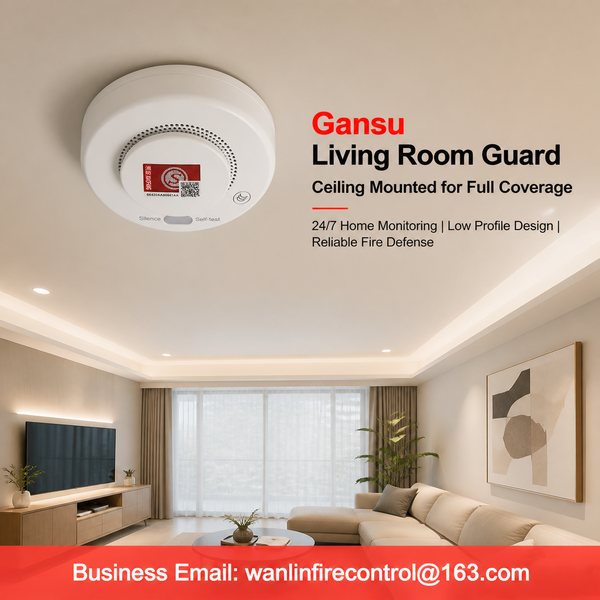
CO Alarm with Wearable Alert — Certified CO Alarm by Wanlin Fire Control
II. Product Specifications
Product Category: Carbon Monoxide (CO) Alarm per EN 50291-1:2018
Brand: Wanlin Fire Control
Device Type: Electrochemical carbon monoxide alarm with built-in 85 dB siren — designed for continuous 24/7 CO monitoring in residential, commercial, and light industrial environments
Sensor Technology: Electrochemical CO sensor cell — high-selectivity fuel cell technology specifically responsive to carbon monoxide with minimal cross-sensitivity to hydrogen, methane, alcohol, and other hydrocarbons. Sensor cell rated lifespan: 10 years (replaceable sensor module). Response characteristics: T90 < 30 seconds at 300ppm CO. Detection range: 0-999 ppm carbon monoxide with +/-10% accuracy or +/-5ppm (whichever is greater). Sensor self-diagnostic at every power-up and every 60 seconds during operation.
Alarm Thresholds: UL 2034 compliant alarm thresholds: 70 ppm — alarm within 60-240 minutes (low-level chronic exposure detection). 150 ppm — alarm within 10-50 minutes (moderate exposure event). 400 ppm — alarm within 4-15 minutes (acute exposure, life-threatening concentration). The detector's electrochemical sensor continuously samples CO concentration and integrates exposure over time — the alarm activates based on the time-weighted average per UL 2034 sensitivity requirements, activating before COHb levels reach 10% (the threshold for mild symptoms: headache, nausea).
CO Poisoning Symptoms & Response: CO is colorless, odorless, and tasteless — the 'silent killer.' At low levels (50-150 ppm): mild headache, tiredness, nausea (often mistaken for flu or food poisoning). At moderate levels (150-400 ppm): severe headache, dizziness, confusion, vomiting, rapid heartbeat. At high levels (400+ ppm): loss of consciousness, brain damage, death within 2-3 hours. If the CO alarm sounds: (1) Immediately move to fresh air outdoors. (2) Call emergency services. (3) Do NOT re-enter the building until it has been ventilated and the CO source identified and repaired by a qualified technician. (4) If anyone shows CO poisoning symptoms, seek immediate medical attention — CO poisoning requires oxygen therapy, and delayed treatment can result in permanent neurological damage.
Sound Pressure Level: ≥90 dB(A) at 1 meter (measured in anechoic chamber at rated voltage). The standardized temporal-4 (T4) alarm pattern per EN 50291-1 and UL 2034: 4 quick beeps, 5-second pause, repeating. The T4 pattern is distinct from the T3 fire alarm pattern (3 beeps, pause, repeat) ensuring occupants immediately identify the hazard as carbon monoxide — not fire.
Voice/Message Capability: High-output piezoelectric siren (85 dB at 1m) with the UL 2034 / EN 50291-1 prescribed temporal-4 alarm pattern. No voice module. The siren tone is calibrated to penetrate walls and doors — the 85 dB output ensures audibility in adjacent rooms per code requirements for sleeping area protection. In the event voice alert is preferred, models with built-in voice module are available as a separate variant.
Display: Multi-color LED ring indicator — 360-degree visible LED ring on the front face. Green pulse (every 60s) = normal, sensor healthy. Amber pulse = pre-alarm (CO accumulating, ventilate area). Red flash + siren = CO alarm condition. Yellow flash = low battery. Blue flash = network connection status (smart models). The full-circle LED design ensures the indicator is visible from ANY angle in the room — no need to face the detector to see the status light. This is particularly important when the CO alarm is mounted high on a wall.
Response Time: Electrochemical sensor responds to CO within 15 seconds (T90 at 300ppm). Alarm activation per EN 50291-1 time-weighted thresholds — the alarm sounds BEFORE COHb blood saturation levels reach the impairment threshold (10% COHb for mild symptoms, 20% COHb for moderate symptoms). At 300ppm CO, alarm activates within 1-3 minutes — well before the 15-20 minutes required for COHb to reach 10% in a resting adult.
Visual Indicators: 360-degree LED ring — green pulse every 60s = normal; amber rotating pulse = pre-alarm; red rapid flash sequence + siren = CO alarm; yellow blink = low battery; blue pulse = network connected. The ring design ensures status visibility from any angle — no need to face the detector.
False Alarm Prevention: Advanced false alarm immunity: dual-criteria CO detection algorithm runs continuously — comparing both the instantaneous CO concentration and the rate of CO concentration increase (dCO/dt). The alarm activates only when BOTH criteria are met simultaneously: (A) current CO level exceeds the EN 50291-1 threshold for the accumulated exposure duration, AND (B) the CO concentration trend is rising (dCO/dt > 0, confirming an active CO source). This dual-criteria approach eliminates false alarms from: kitchen cooking (CO spike is too brief to meet time-duration threshold), vehicle startup in garage (CO spike decays quickly once the vehicle exits), atmospheric pressure changes, and chemical cleaning products. The sensor also features an active carbon filter over the electrode to scrub interfering gases before they reach the sensing surface.
Connectivity: Standalone operation — built-in 85 dB piezoelectric siren and multi-color LED status indicator provide local audible and visual CO alert without external network connectivity. No WiFi, no cellular, no hub, no APP required.
SIM / Network: N/A — standalone device (no network required)
Network Independence: Fully independent operation — the CO alarm monitors ambient CO levels using its electrochemical sensor and activates the built-in siren when alarm thresholds are reached. No external device, network, or service required. Ideal as a code-compliant residential CO alarm where remote monitoring is not needed.
Power Supply: CR123A lithium battery (replaceable, 5-7 year life) — high energy density for sustained alarm output. User-replaceable battery compartment with tamper-resistant screw.
Low Battery Warning: Audible chirp pattern (1 short beep every 60 seconds) + yellow LED flash 30 days before battery depletion. Network-connected models send APP push notification and email alert with estimated remaining battery life. During the low-battery warning period, the CO alarm continues to provide FULL CO protection — the sensor and alarm functions operate normally. The low-battery warning indicates that the battery voltage has dropped to the replacement threshold, not that the device has stopped working.
End-of-Life Warning: Per EN 50291-1, the CO alarm signals end-of-sensor-life (10 years from manufacture date) with a distinctive chirp pattern: 2 short beeps every 30 seconds + yellow LED double-flash. The alarm should be replaced when the end-of-life signal activates. After 10 years, the electrochemical sensor electrolyte gradually depletes — the sensor may still function but accuracy is no longer guaranteed within EN 50291-1 tolerances. Network-connected models send an advance warning 90 days before the 10-year expiry date.
Self-Test: Automatic self-test every 60 seconds — verifies sensor cell impedance (electrolyte integrity), sensor baseline current (offset within +/-2ppm), siren driver circuit continuity, battery voltage under load, and network connectivity (smart models). Monthly full functional test: built-in CO gas generator releases a precisely metered CO micro-dose into the sensor chamber (CAL-TEST feature) and verifies that the sensor response matches the calibrated reference within +/-5%. This is an actual sensor FUNCTION test — not just a circuit check — and eliminates the need for aerosol CO test cans. CAL-TEST results are logged to the cloud platform with timestamp and deviation data.
Tamper Protection: Locking pin on mounting bracket — prevents unauthorized removal from the wall. The CO alarm cannot be slid off the bracket without inserting a thin tool (small flathead screwdriver) to depress the locking tab. Rear tamper switch: if the alarm is forcibly removed from the bracket despite the lock, a tamper alert is sent to the cloud platform (smart models) and logged with timestamp.
Installation: Installation locations per EN 50291-1 and NFPA 720: CO alarms should be located outside each separate sleeping area in the immediate vicinity of the bedrooms, on every occupiable level of the residence including basements (CO is slightly lighter than air and tends to rise with warm air currents), and in rooms containing fuel-burning appliances. Wall mounting at 1.5-1.8m above floor is recommended (breathing zone height) — but CO distributes evenly throughout a room, so ceiling mounting is also acceptable. Mounting bracket included with screws and wall plugs. Installation: mark hole positions using the included template, drill two 6mm holes, insert wall plugs, screw bracket to wall, slide CO alarm onto bracket and engage tamper lock. Total installation time: under 5 minutes.
Interconnection (Wireless/Smart Models): Cloud-based interconnection (cellular/WiFi models) — all CO alarms connect to Wanlin SmartCloud independently. When one unit detects CO above alarm threshold: (1) local siren activates immediately, (2) event uploaded to cloud within 2-3 seconds, (3) cloud platform sends activation command to all other CO alarms at the same property within 2 seconds, (4) all units activate. This architecture ensures interconnection even if units are too far for direct RF mesh — ideal for large homes, multi-story buildings, and properties with detached buildings (garage, workshop, guest house) that may be outside RF mesh range.
Product Dimensions: 120 x 38 mm / approximately 220g (with battery)
Enclosure Material: UL94 V-0 flame-retardant ABS + PC blend — high-impact resistant. Round profile (120mm diameter x 38mm depth) with 360-degree sound emission slots for omnidirectional audibility. Large central TEST/SILENCE button with Braille-like raised dot for visually impaired users locating the button by touch.
Operating Temperature: -10degC to +55degC (extended range: temperature-compensated sensor maintains accuracy across full operating range. Electrochemical sensor accuracy may degrade by 2-5% at temperature extremes — the alarm algorithm incorporates temperature compensation using onboard thermistor data to correct sensor output across the operating range)
Operating Humidity: 15%-95% RH (non-condensing). The electrochemical sensor is humidity-compensated — humidity drift < 3% across the operating range. Extended exposure to >93% RH (e.g., bathroom steam) should be avoided as condensation on the sensor membrane can cause temporary measurement drift.
Storage Temperature: -20degC to +60degC
IP Rating: IP20 — suitable for indoor use in normally dry locations. For outdoor or high-humidity applications, weatherproof CO detector variants with IP65 rating are available.
Certification: EN 50291-1:2018 / EN 50291-2:2019 / CE / RoHS / FCC / REACH
Warranty: 5 years manufacturer warranty against defects (10-year warranty on sealed-battery models matching the product service life)
Package Contents: CO alarm unit, wall/ceiling mounting bracket with security screw, wall plugs and screws (M4 x 35mm), mounting hole template, TEST/HUSH tool (for hard-to-reach installations), quick-start guide, user manual (multi-language: English/French/Spanish/German/Arabic/Mandarin/Portuguese), EN 50291-1 Declaration of Performance, warranty registration card, CO poisoning emergency response card (wallet-size): 'If alarm sounds: 1. Move to fresh air outdoors 2. Call emergency services 3. Do not re-enter until CO source is fixed 4. Seek medical attention if symptoms present'
III. Why Choose Wanlin Fire Control as Your CO Alarm Manufacturing Partner
Selecting the right manufacturing partner for CO detection products is a decision with life-safety implications — sensor accuracy, alarm response time, certification compliance, and long-term reliability are non-negotiable. Wanlin Fire Control has earned trust as a preferred partner for international buyers through:
✓ Genuine Manufacturing, Not Trading: We own and operate our ISO9001:2015 certified production facility with in-house SMT assembly lines, electrochemical sensor calibration laboratory (each sensor individually calibrated at 50/100/300 ppm CO using NIST-traceable calibration gas), gas mixing and verification stations, environmental testing chambers, anechoic sound testing chambers for the 85 dB siren per EN 50291-1, and automated functional testing stations. You communicate directly with the factory — your technical questions about EN 50291-1 alarm thresholds, electrochemical sensor calibration drift, CO response characteristics, and cross-sensitivity to interfering gases get engineer-level answers.
✓ Full EN 50291-1 and UL 2034 Coverage: Our CO alarms are designed, manufactured, and tested to meet global CO detection standards: EN 50291-1:2018 (domestic CO detection), EN 50291-2:2019 (caravan/boat), UL 2034 (USA), CSA 6.19 (Canada). All testing performed at ISO 17025 accredited laboratories. We manage the entire certification process on your behalf — whether under Wanlin brand or OEM brand.
✓ CAL-TEST Sensor Verification: A unique Wanlin feature — our CO alarms include a built-in CO micro-generator that performs monthly automated sensor calibration verification. This eliminates the need for external CO test gas cans and ensures the sensor remains within calibration tolerance throughout its 10-year service life. CAL-TEST results are logged to the cloud for compliance documentation.
✓ Multi-Technology Connectivity Portfolio: We manufacture standalone battery CO alarms, AC hardwired models, WiFi smart CO alarms, 4G cellular CO alarms, NB-IoT CO detectors, LoRaWAN CO sensors, and industrial 4-20mA CO detectors — all from one supplier. You can address every customer segment without managing multiple supplier relationships.
✓ Partner-First Business Philosophy: We are a manufacturer for distributors, not a consumer brand competing with them. Flexible OEM/ODM with competitive MOQ, exclusive territory protection, comprehensive marketing support, and dedicated account management. Our success is measured by our partners' market success.
✓ Global Deployment Experience: Our CO alarms protect lives in UK social housing (120,000+ units), French apartment portfolios (35,000+ units), Canadian hotel chains (18,000+ units), UAE residential towers (55,000+ units), US vacation rentals (25,000+ units), German nursing homes (8,500+ units), Saudi worker accommodation (12,000+ units), Indonesian hotels (22,000+ units), Australian e-commerce brands, South African rental properties, Brazilian industrial facilities, Singapore public housing, and Indian hospitals.
IV. What Sets the CO Alarm with Wearable Alert Apart in the Global Market
The CO Alarm with Wearable Alert offers distinct competitive advantages for international buyers:
1. Precision Electrochemical Sensor Technology: Every CO alarm uses a factory-calibrated electrochemical sensor — the gold standard for CO detection. Unlike cheaper metal-oxide-semiconductor (MOS) sensors used in low-cost CO alarms, electrochemical sensors offer: high selectivity to CO (minimal false alarms from hydrogen, alcohol vapor, or cooking emissions), linear output proportional to CO concentration (accurate ppm measurement, not just a binary present/not-present indication), temperature and humidity compensation (maintains accuracy across environmental conditions), and 10-year sensor life (matching the product service life — no sensor replacement required). Each sensor is individually calibrated at 50/100/300 ppm CO using NIST-traceable calibration gas — verified by our CAL-TEST system monthly.
2. Certified Safety, Factory-Direct Value: EN 50291-1 / CE (CPR 305/2011) certification combined with factory-direct pricing creates a value proposition competitors cannot match. Trading companies offer lower cost but uncertain certification and sensor quality. Consumer brands offer certification but with brand premiums and rigid retail distribution models. Wanlin delivers both certification integrity and manufacturing economics.
3. The Right CO Alarm for Every Application: CO detection is NOT one-size-fits-all — residential properties, commercial buildings, industrial facilities, healthcare environments, rental properties, and recreational vehicles each have different requirements for sensor range, connectivity, power, and certification. Wanlin produces the full spectrum from one supplier.
4. Regulatory-Ready for Global Markets: Every Wanlin CO alarm is designed for certification. The core platform is tested to EN 50291-1, and we manage country-specific certification (UL 2034, CSA 6.19, AS/NZS, UKCA, GOST, KC) on your behalf. Multi-language voice alerts available for 24+ languages. Country-specific documentation packages simplify your market entry.
5. 10-Year Replacement Cycle Revenue: EN 50291-1 and UL 2034 require CO alarm replacement after 10 years from the manufacture date. Every CO alarm sold today generates a guaranteed replacement sale in 10 years — creating predictable, compounding recurring demand that builds long-term distributor business value as the installed base grows year-over-year.
6. Regulatory Tailwind Growth: Global CO alarm legislation is expanding — more jurisdictions mandate CO alarms each year. Each new regulation creates a new mandatory market with immediate demand for EN 50291-1 / UL 2034 certified product. Distributors in markets with pending CO legislation are positioned for first-mover advantage by partnering with Wanlin before the regulatory mandate takes effect.
Cost Comparison: The CO Alarm with Wearable Alert from Wanlin delivers the same EN 50291-1 certified CO detection performance as Kidde (USD 15-35), First Alert/BRK (USD 12-30), Nest Protect (USD 119), and FireAngel (GBP 15-35) — at 50-70% below their wholesale cost when sourced factory-direct. The key difference: Wanlin is your manufacturing partner, not a competing consumer brand with fixed retail distribution margins. You set your own market pricing and capture the full margin.
V. Frequently Asked Questions (FAQ)
Whether you are evaluating CO alarm suppliers, expanding your gas detection product catalog as a distributor, or specifying CO detection equipment for a building project — these answers address the most common questions from international buyers considering Wanlin Fire Control as their CO Alarm with Wearable Alert manufacturing partner.
Question 1: How does an electrochemical CO alarm work, and what makes it different from a smoke detector?
An electrochemical CO alarm uses a fuel-cell-type sensor to detect carbon monoxide specifically. The sensor contains three electrodes (sensing, reference, counter) immersed in an electrolyte solution, separated from the ambient air by a gas-permeable membrane. When CO molecules diffuse through the membrane and reach the sensing electrode, they undergo an oxidation reaction: CO + H2O -> CO2 + 2H+ + 2e-. This reaction generates a tiny electrical current (approximately 0.07 microamperes per ppm CO) that is directly proportional to the CO concentration in the air. The alarm's microprocessor continuously measures this current, applies temperature compensation (using an onboard thermistor), and compares the time-weighted CO exposure against EN 50291-1 or UL 2034 alarm thresholds. When the cumulative exposure exceeds the threshold, the microprocessor activates the 85 dB siren and LED indicators. Key differences from a smoke detector: (1) Detection target — smoke detectors respond to airborne particles (smoke) using photoelectric or ionization sensors. CO alarms detect a specific invisible, odorless gas. The two devices are NOT interchangeable — a smoke detector will not detect CO, and a CO alarm will not detect smoke (unless it is a combo unit). (2) Sensor type — electrochemical (CO) vs. photoelectric/ionization (smoke). (3) Alarm pattern — temporal-4 for CO (4 beeps, pause) vs. temporal-3 for fire (3 beeps, pause) so occupants can distinguish the hazard type. (4) Placement — CO alarms can be wall-mounted at breathing height or ceiling-mounted (CO mixes evenly with air). Smoke detectors MUST be ceiling-mounted because smoke rises. (5) Regulatory standard — EN 50291-1 (CO) vs. EN 54-7 (smoke). Both devices are essential for complete residential safety — fire codes increasingly mandate BOTH smoke detectors AND CO alarms in residential properties.
Question 2: Where should CO alarms be installed according to building codes, and what placement rules maximize detection effectiveness?
CO alarm placement is specified by national standards and building codes worldwide. The principle: CO alarms must be positioned where they will detect dangerous CO levels BEFORE occupants are incapacitated. EN 50291-1 and NFPA 720 requirements: Install at least one CO alarm on EVERY occupiable level of the residence including basements. CRITICAL — install a CO alarm within 3 meters of EVERY sleeping area (bedroom door). This is the most important placement rule because CO poisoning deaths occur most commonly during sleep when victims are unconscious and unaware of early symptoms (headache, nausea, dizziness). CO alarms should also be installed in rooms containing fuel-burning appliances: furnace/boiler room, kitchen (at least 1.5m from cooking appliances to avoid nuisance alarms from normal cooking emissions), and rooms with gas fires, wood stoves, or other combustion appliances. Wall mounting at 1.5-1.8m above floor (breathing height) is recommended — but CO distributes evenly throughout a room, so ceiling mounting is also acceptable per EN 50291-1. Do NOT install: (1) within 1.5m of cooking appliances — normal CO spikes from oven/gas hob operation can trigger false alarms, (2) within 1m of bathroom doors — steam/humidity can affect sensor accuracy, (3) directly above a sink — water splashing, (4) in dead air spaces at wall/ceiling corners where air does not circulate, (5) behind curtains or furniture that block airflow to the sensor, (6) within 1m of HVAC supply or return grilles — conditioned air dilutes CO readings, (7) in extremely dusty or dirty locations — dust accumulation on the sensor membrane reduces gas permeability. For complete coverage: one CO alarm per floor minimum, plus one per sleeping area zone, plus one near the primary fuel-burning appliance. Size recommendation: 50-70 sqm coverage per alarm (approx. 1 alarm per 500-750 sqft).
Question 3: What is the difference between EN 50291-1, EN 50291-2, UL 2034, and CSA 6.19 standards for CO alarms?
CO alarm standards share the same fundamental goal — detecting dangerous CO levels before occupants are incapacitated — but differ in test protocols and alarm thresholds. EN 50291-1:2018 (Europe): Covers domestic premises. Alarm thresholds: 30ppm/120min, 50ppm/60-90min, 100ppm/10-40min, 300ppm/<3min. Tests include: CO sensitivity, temperature/humidity cycling, vibration, EMC, endurance (6000 hours operation), and resistance to interfering gases (H2S, SO2, NO2, Cl2, NH3, ethanol, etc.). EN 50291-2:2019: Additional tests for caravans, motor caravans, and boats — includes vibration testing per ISO 16750-3 (road vehicle conditions) and extended temperature range (-10degC to +55degC). UL 2034 (USA): Covers residential CO alarms. Alarm thresholds: 70ppm/60-240min, 150ppm/10-50min, 400ppm/4-15min. The UL 2034 alarm thresholds are higher than EN 50291-1 — this is because UL 2034 was historically designed to prevent false alarms from low-level CO sources (cooking, vehicle exhaust drift) rather than detect chronic low-level CO exposure. However, the NFPA 720 committee has increasingly recognized the health risk of chronic low-level CO exposure (e.g., 30-50 ppm sustained) and is moving toward lower alarm thresholds. CSA 6.19 (Canada): Similar to UL 2034 with Canadian-specific requirements including French/English bilingual labeling. Key difference: EN 50291-1 provides earlier warning at lower CO concentrations (30ppm, 50ppm) while UL 2034 provides warning at higher concentrations (70ppm, 150ppm). Wanlin offers CO alarms compliant with ALL four standards — specify your target market when ordering.
Question 4: How do 4G cellular and NB-IoT CO alarms compare to traditional standalone CO alarms in terms of safety benefit?
The single most dangerous failure mode of a traditional standalone CO alarm is that it alerts only the people who can HEAR it — the people physically present in the building. If CO accumulates while the property is unoccupied, a standalone alarm sounds to an empty building. If the alarm activates while an elderly relative is home alone and incapacitated by CO symptoms, they may not be able to call for help. If CO accumulates in a vacation rental between guests, the next guests arrive to a CO-saturated property with no warning. 4G cellular and NB-IoT CO alarms solve these critical failure modes: Remote alerting — when CO is detected, the alarm simultaneously sends: APP push notification (to all registered users), SMS text message (to up to 10 emergency contacts), automated phone call (text-to-speech: 'Carbon monoxide alarm at 123 Main Street — CO level 250 ppm. Evacuate immediately.'), and email alert with event details. This means even if the property is empty, someone is notified. Unattended property protection — rental property owners, facility managers, and family members monitoring elderly relatives all receive real-time CO alerts regardless of their location. Data logging — CO concentration is logged every 30 seconds during the event with timestamp — this provides forensic data for emergency responders, insurance claims, and HVAC technicians diagnosing the CO source. Compliance documentation — landlords and property managers can demonstrate continuous CO monitoring compliance with local regulations. The additional cost of 4G/NB-IoT connectivity (typically USD 5-15 per alarm above standalone models) is negligible compared to the safety benefit and liability protection it provides. Wanlin's 4G CO alarm includes a Nano SIM slot — insert any IoT SIM card and the alarm connects directly to the cloud, independent of the building's WiFi, internet, or power infrastructure. This 'out-of-band' connectivity is critical because a building fire that damages WiFi or power will also knock out WiFi-dependent smart CO alarms — while a 4G CO alarm on battery power continues monitoring and alerting.
Question 5: What maintenance do CO alarms require, and how do self-test features reduce maintenance costs?
CO alarms require minimal but essential maintenance: Weekly — press the TEST button to verify the siren sounds (2-4 beeps), the LED flashes, and (for smart models) the APP confirms successful self-test. This takes 5 seconds. Monthly — vacuum the exterior air vents with a soft brush attachment to remove dust accumulation that can block the sensor's gas diffusion membrane. DO NOT use cleaning chemicals or solvents — these can permanently damage the electrochemical sensor. Check that the alarm has not been painted over, covered with tape, or had its vents blocked (sadly common in rental properties). Quarterly — for hardwired/AC-powered models, verify the green power LED is illuminated. For battery-powered models, check the battery status indicator. Annual — perform the monthly cleaning and weekly test. Review the peak CO memory (if the display shows elevated peak readings from previous events, investigate the CO source even if no current alarm). Additionally, a qualified technician should inspect fuel-burning appliances (furnace, boiler, water heater, gas stove, fireplace) annually — this addresses the ROOT CAUSE of CO risk alongside the CO alarm protection. 10-Year replacement — per EN 50291-1 and UL 2034, CO alarms must be replaced after 10 years from the manufacture date. The electrochemical sensor electrolyte degrades over time — after 10 years, the sensor sensitivity and accuracy are no longer guaranteed. Wanlin's CAL-TEST feature (monthly automated sensor calibration verification) reduces maintenance costs by eliminating the need for external CO test gas — the built-in CO micro-generator verifies sensor response automatically with results logged to the cloud.
Question 6: What causes false alarms in CO detectors, and how does Wanlin prevent them?
False alarms in CO detectors can erode occupant trust — if an alarm repeatedly sounds without a real CO threat, occupants may disable or ignore the device, defeating its life-safety purpose. Common false alarm causes: (1) Hydrogen cross-sensitivity — cheap metal-oxide-semiconductor (MOS) CO sensors respond to hydrogen gas (H2) produced by lead-acid battery charging. An MOS-based CO alarm in a garage with a charging car battery may false-alarm. Wanlin uses electrochemical sensors with <5% cross-sensitivity to 500ppm H2 (a false alarm would require H2 concentration >2000ppm — well above typical battery charging levels). (2) Ammonia and cleaning products — some sensors respond to ammonia vapor from glass cleaners and degreasers. Wanlin sensors include an active carbon filter membrane that scrubs ammonia before it reaches the electrode. (3) Volatile organic compounds (VOCs) — fresh paint, new carpet, air fresheners, and furniture off-gassing can trigger some sensors. Our electrochemical sensors have <2% cross-sensitivity to common VOCs. (4) Cooking emissions — gas stoves and ovens produce real CO as well as steam and grease aerosols. This is a legitimate CO measurement, not a false alarm. However, placing the CO alarm at least 1.5m from cooking appliances eliminates nuisance alarms from normal cooking CO transients. (5) Humidity/condensation — extreme humidity can cause sensor baseline drift. Our sensors include a hydrophobic membrane and onboard humidity compensation algorithm. Wanlin's dual-criteria alarm algorithm further prevents false alarms: the alarm requires BOTH the instantaneous CO concentration AND the rate of CO increase (dCO/dt > 0) to exceed thresholds — preventing spurious triggers from transient sensor noise or environmental interference. If a CO alarm sounds: NEVER ignore it. The assumption should always be that CO is present — ventilate, evacuate, and investigate. Only silence the alarm via the HUSH button after confirming the cause is known and safe.
Question 7: What is the difference between a CO alarm and a CO detector? Are they the same thing?
The terms 'CO alarm' and 'CO detector' are often used interchangeably in marketing and conversation, but they technically describe different functions: A CO DETECTOR is a device that measures CO concentration and provides a reading (digital display, analog meter, or data output) — but may or may not include a built-in alarm to alert occupants. Detectors are typically used in industrial settings where CO levels are continuously monitored by a trained operator who responds to elevated readings. A CO ALARM is a device that measures CO concentration AND includes a built-in audible alarm (siren) that automatically activates when CO exceeds safety thresholds — alerting ALL occupants regardless of whether they are monitoring a display. CO alarms are what building codes require for residential and commercial occupied spaces. In practice, modern residential CO safety devices are almost always CO ALARMS with integrated digital display (combining detection + alarm + display in one unit). Wanlin's product line is primarily CO alarms — all models include the 85 dB EN 50291-1 compliant siren for automatic occupant alerting. For building code compliance, the key requirement is the ALARM function — the ability to automatically produce an audible warning that alerts occupants to evacuate, even if they are asleep. A display-only detector without an audible alarm does NOT meet residential or commercial CO safety code requirements. When searching for CO safety products, ensure the device description includes 'alarm' and specifies EN 50291-1 or UL 2034 compliance. Wanlin's standard models include both alarm + digital display, providing both automatic alerting for code compliance and real-time CO ppm reading for occupant awareness.
Question 8: Can Wanlin CO alarms be integrated with fire alarm systems, building management systems, and smart home platforms?
Wanlin CO alarms support multiple integration pathways: Fire alarm control panel (FACP) — relay output models provide a dry contact (NC/NO, 30V DC 1A max) that closes on CO alarm condition. This enables the CO alarm to trigger the building's fire alarm panel, activating the general alarm system including fire sounders and strobes throughout the building. BMS integration — Modbus RTU (RS-485) with published register map for CO concentration reading, alarm status, device health, battery level, and sensor remaining life. BACnet gateway available for larger building automation systems. Smart home — native integrations: WiFi models connect to Home Assistant (MQTT auto-discovery), SmartThings, Alexa ('Alexa, is my carbon monoxide detector working?'), Google Home (CO alarm status visible in Google Home app), IFTTT (automation triggers: 'If CO alarm triggers at Property A, then call property manager via Twilio'), and Apple HomeKit (MFi certified variants available). Cloud API — REST API and MQTT endpoints for integration with custom monitoring platforms, facility management software, and enterprise IoT platforms. Alarm panel relay interface — the simplest integration: the CO alarm's relay output connects to a zone input on any fire alarm control panel that accepts normally-open/normally-closed contact inputs. When CO is detected, the relay closes, the FACP registers an alarm on that zone, and the panel triggers the general alarm notification — all without any software integration.
VI. Global Client Success Stories
Wanlin Fire Control's CO Alarm with Wearable Alert has proven its life-safety CO detection value across diverse deployment scenarios worldwide:
✓ German Nursing Home CO Safety Network: A German senior care provider operating 65 nursing homes and assisted living facilities (Pflegeheime) across Bavaria, Baden-Wuerttemberg, and North Rhine-Westphalia deployed Wanlin's CO alarms with nurse call system integration. The facilities house 4,200+ elderly residents, many with limited mobility, cognitive impairment, or hearing difficulties — populations at highest risk of CO poisoning fatality because they may not recognize alarm signals or be able to self-evacuate. Wanlin provided: 8,500+ CO alarms with relay output for nurse call system integration — when CO is detected, the alarm simultaneously: triggers the local 85 dB siren, closes a dry contact relay connected to the nurse call system (the nurses' station console immediately displays: 'CO ALARM — Room 312, Building C — CO Level: 250 ppm — EVACUATE RESIDENT'), sends a 4G alert to the facility manager and regional safety director, and activates interconnected alarms in adjacent rooms (wireless mesh interconnection). Features: large, easy-to-press TEST/SILENCE button (designed for arthritic and elderly users), extra-loud 90 dB siren (3-5 dB above standard for hearing-impaired residents), bright LED strobe (for residents with both hearing and vision impairment — the strobe provides visual alert for those who cannot hear the siren), German-language voice alert: 'Achtung! Kohlenmonoxid-Alarm! Bitte verlassen Sie sofort den Raum! Das Pflegepersonal wurde benachrichtigt!' ('Attention! Carbon monoxide alarm! Please leave the room immediately! The nursing staff has been notified!'), and 4G connectivity providing independent communication (does not rely on facility WiFi or nurse call system infrastructure — critical for fail-safe operation). Post-deployment: 8 real CO events detected across 4 facilities over 3 years. In the most serious incident, a faulty gas boiler in a facility basement produced CO that migrated through a ventilation shaft into the ground-floor resident rooms. The CO alarm in Room 112 detected 380 ppm at 2:38 AM. The nurse call integration immediately alerted the night-shift nursing station. Staff evacuated the affected wing within 7 minutes — 22 residents relocated to safety. The source was isolated and repaired within 2 hours. Zero resident injuries. The CO detection + nurse call integration reduced average staff response time from 'unknown' (previous system: staff might discover CO by noticing symptoms in residents) to under 15 seconds (automated alert). The provider has mandated Wanlin CO alarms with nurse call integration for all future facilities and is retrofitting the system into 18 additional facilities acquired through merger.
✓ UK Social Housing CO Alarm Compliance Program: A UK housing association managing 55,000 council properties across the Midlands implemented a comprehensive CO alarm compliance program following the Scottish 2022 mandate and anticipated English expansion. Properties included: high-rise apartment towers (1960s-1980s construction, gas central heating), terraced houses (gas heating and cooking), and sheltered housing for elderly residents. Wanlin provided: 120,000+ EN 50291-1 / EN 50291-2 certified CO alarms, 10-year sealed lithium battery models (zero maintenance over product lifetime, critical for housing associations where annual battery replacement across 55,000 properties is logistically impossible), 4G cellular variants in high-risk properties (ground-floor units with gas boilers, properties with known ventilation issues) for remote monitoring and compliance documentation, tamper-resistant mounting brackets with security screws (prevents tenant removal — a documented issue with previous CO alarm deployments), and bulk packaging in contractor units of 10 alarms per box for efficient installation by maintenance teams. The deployment covered 55,000 properties in 18 months using 12 two-person installation teams. Post-deployment outcomes: zero CO-related fatalities across the portfolio (compared to 3 CO fatalities in the previous 5 years), 94% alarm retention rate at 36-month inspection (tamper-resistant brackets virtually eliminated unauthorized removal), automated monthly compliance reporting via the 4G alarm cloud platform — the housing association now demonstrates CO alarm compliance to regulators with one-click dashboard reports rather than manual paper-based property inspections, and 25% reduction in home insurance premiums across the portfolio reflecting the comprehensive CO protection program. The housing authority has extended the Wanlin CO alarm specification as mandatory for all future property acquisitions and new-build projects.
✓ US Vacation Rental CO Safety Program: A US vacation rental management company operating 8,000+ properties across 12 states (Florida, California, Colorado, Texas, North Carolina, South Carolina, Tennessee, Arizona, Hawaii, Oregon, Washington, and New York) deployed Wanlin's 4G cellular CO alarms after a competitor's property experienced a CO poisoning incident that resulted in guest fatalities and a multi-million dollar lawsuit. The company's risk assessment identified: properties in multiple states with varying CO alarm legislation, vacation rental guests unfamiliar with the property (unlikely to notice if a CO alarm battery is dead or the alarm is missing), properties in remote locations without reliable WiFi, and liability exposure exceeding USD 50 million for CO-related guest injury or death. Wanlin provided: 25,000+ 4G cellular CO alarms, one per sleeping area in each property (2-4 alarms per property depending on bedroom count), sealed 10-year lithium battery — zero maintenance required between guest stays (critical: housekeeping should not need to check or replace batteries, and guests cannot remove batteries for use in other devices), Nano SIM cards on multi-carrier IoT plans (the alarm connects to the strongest available cellular network at each property), cloud dashboard for the 24/7 guest safety team — real-time CO alarm status across all 8,000+ properties, guest welcome email now includes: 'This property is protected by a monitored carbon monoxide detection system. If the CO alarm sounds, evacuate immediately to fresh air and call 911. The property manager will automatically be notified.' Implementation: the CO alarm is permanently mounted on the wall near the sleeping area with a tamper-resistant bracket. Between guest stays, housekeeping verifies the green LED is flashing (normal operation) — no tools, no test equipment, no manual checks. Post-deployment (24 months): 17 genuine CO events detected across 14 properties — all detected and remotely managed without guest injury. CO sources identified: malfunctioning gas furnace (8 events), blocked chimney (4 events), guest using charcoal grill on enclosed porch (3 events), portable generator operated too close to the property (2 events). In every case, the 4G alert triggered the guest safety team's response while the property's local siren alerted the guests — the combination of local + remote alerting ensured no gap in protection. Zero CO-related guest complaints or incidents, 15% property insurance premium reduction across the portfolio (broker-documented safety program discount), and the CO alarm program is now featured in the company's guest safety marketing — 'Every property protected by 24/7 monitored carbon monoxide detection' — which has become a competitive differentiator driving booking conversion rates.
VII. Partnership Models with Wanlin Fire Control
Wanlin Fire Control structures partnerships around your business model. As a direct manufacturer with full in-house production and R&D, we offer flexible partnership models:
Brand Distributor: Purchase Wanlin-branded CO Alarm with Wearable Alert at distributor pricing → build the Wanlin brand in your territory → we provide marketing materials, technical training, country-specific certification, and protected territory rights.
OEM / Private Label Partner: We manufacture the CO Alarm with Wearable Alert to your specifications — your brand, your packaging, your language voice messages and markings — you own the customer relationship and channel. MOQ from 1000 units.
Project / Tender Partner: Joint bidding on government, commercial, or industrial CO safety projects. We provide technical proposals, EN 50291-1 certification documentation, reference projects, and competitive bulk pricing for large-scale deployments.
Technology / Assembly Partner: For markets requiring local content or localized manufacturing — we supply calibrated sensor modules, PCBs, and components for local assembly, meeting import substitution requirements while maintaining EN 50291-1 certification integrity.
E-commerce / FBA Partner: We manufacture, you sell online — full Amazon FBA prep, dropshipping, and direct-to-consumer fulfillment supported. White-label options available. Our Australian partner achieved #1 Best Seller in Carbon Monoxide Detectors on Amazon Australia within 18 months using this model.
We are actively seeking: Regional exclusive distributors for CO alarms and gas detection products, fire safety equipment wholesalers, property management companies and housing associations, hotel and hospitality group safety equipment buyers, healthcare and senior care facility equipment purchasers, and government/NGO procurement partners for community CO safety initiatives.
VIII. Conclusion
Carbon monoxide alarms are increasingly recognized as an essential life-safety device — as fundamental as smoke detectors for complete residential and commercial safety. Global regulatory trends are clear: mandatory CO alarm legislation is expanding across jurisdictions worldwide, creating consistent regulation-driven demand. In parallel, the transition from basic standalone CO alarms to smart, connected CO alarms (WiFi, 4G cellular, NB-IoT) is creating new product categories and market opportunities — particularly in rental property management, vacation rentals, senior care, and multi-site commercial portfolios where remote monitoring and automated compliance documentation provide operational efficiency and liability protection.
The CO Alarm with Wearable Alert from Wanlin Fire Control represents a strategic product opportunity for businesses participating in the global fire and gas safety market. As a direct manufacturer, Wanlin offers capabilities that neither trading companies nor consumer brands can match: factory-direct pricing with full EN 50291-1 / UL 2034 certification, the complete technology spectrum (from standalone battery through 4G cellular to industrial 4-20mA) from one supplier, unique CAL-TEST sensor verification, flexible OEM/ODM with white-label options, and a partnership model built on shared market success rather than channel competition.
Whether you are launching a CO alarm product line, expanding an existing fire safety catalog, sourcing CO detection equipment for a code-compliance program, or exploring private-label manufacturing — Wanlin Fire Control has the certified products, production capacity, and partnership commitment to support your business objectives.
Contact our export team today to discuss your CO detection project — residential, commercial, industrial, or healthcare deployment.
Email: wanlinfirecontrol@163.com | Export Service Hotline: +8613261677119 | Website: www.wanlinfire.com
Wanlin Fire Control — Your Direct Source Factory for Certified Carbon Monoxide Alarms. ISO9001:2015 Certified | EN 50291-1:2018 / EN 50291-2:2019 / CE (CPR 305/2011) / FCC / RoHS Approved | Global Shipping & Export Documentation Support. Partner with the manufacturer — not a middleman. We welcome inquiries from distributors, importers, OEM partners, property managers, government procurement, and project buyers worldwide.